
Evocations of a long forgotten Lodge

Evocations
Evocations - In Beauchamp Lodge’s archives there is a fascinating, but unpublished, history of Freemasonry in Bengal & The Punjab written by Bro. F. Collinge (WM 1945 & 1973). One chapter is devoted to the history of Beauchamp Lodge, this tells us how it was founded by military Brethren during the time of the British Raj.
The lodge was warranted to meet at Roorkee in Northern India, where there was a large military depot and engineering college; but the lodge would also sometimes meet by special dispensation in war zones if Brethren were there on active service, some other military lodges had special travelling warrants that permitted them to meet wherever they were stationed.
Evocations - However, this article is about a much more unusual military lodge mentioned by Bro. Collinge, the Seaforth Lodge. It was unusual in that it was specifically warranted to meet within hostile occupied territory; a popular lodge it had nearly 200 members, but given their military duties meeting attendances would have fluctuated widely.
The Seaforth Lodge was formed during the 2nd Afghan War (1878-1880); this war was one of several campaigns fought to prevent Russia from gaining influence in Afghanistan, and thereby threaten the British control of India.
Evocations - The 1st phase of the War began with c40,000 British troops, mostly of Indian birth, successfully invading Afghanistan from India. In May 1879 the Emir of Afghanistan was forced to sign a peace treaty; but it was an uneasy peace, and in September the conflict would re-ignite when the British Mission in Kabul, Afghanistan’s capital, was massacred by mutinous Afghan troops.
The 2nd phase of the war began with General Frederick Roberts, known as ‘Little Bobs’, leading a punitive British expeditionary force into Afghanistan in order to occupy Kabul; which he successfully did in October 1879, after defeating the Afghans at Charasiab.
Evocations continued - Once in Kabul General Roberts set his engineers to repairing and improving the Sherpur Cantonment, a fortified military camp a mile north of the city. The Bemaru Hills formed one side of its fortifications, on the other three sides were high mud walls, with parapets and bastions for guns. Just inside the cantonment and parallel to the outer mud walls was a row of mud and brick built barracks-rooms, which provided a second line of defence; the centre of the cantonment was largely an open assembly area where temporary buildings and tents could be erected.
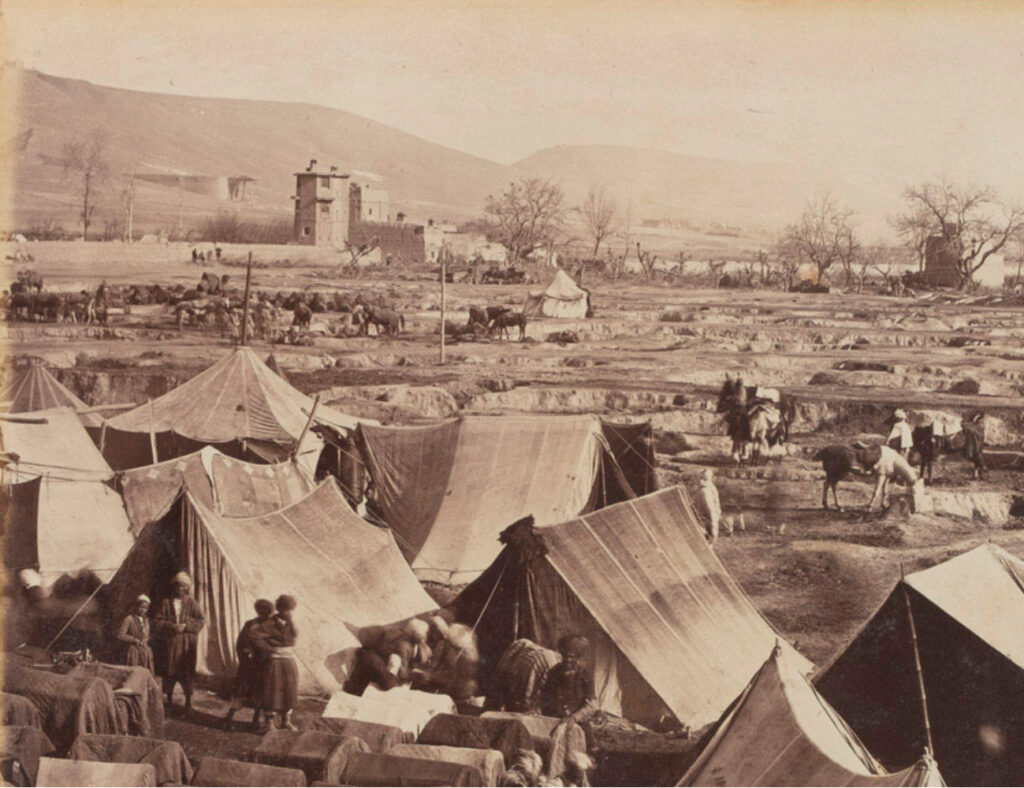
The Royal Engineers Park at Sherpur 1879
Evocations continued - The limited British forces made manning the cantonment’s 4½ mile rectangular perimeter difficult, especially the less fortified section running along the Bemaru Hills; but General Roberts still made it his winter headquarters, as he felt it more easily defended than Kabul itself.
The above photograph was taken within the cantonment by a member of the 7th Company Bengal Miners & Sappers; their home base was at Roorkee, so the photographer could have been a member of Beauchamp Lodge, the lodge did we know go into abeyance in 1880 as its members were mostly in Afghanistan.
After receiving reports that the Afghans were massing their forces to attack, General Roberts ordered his Sappers to further strengthen Sherpur’s defences. To aid communications telegraph lines were laid around the cantonment, more towers were erected and new trenches dug.
He also sent out sorties; not only to protect his lines of communication, but also to locate and hopefully disperse the gathering tribesmen. During one such sortie the Rev. J.W. Adams became the first army Chaplain to win a Victoria Cross; under heavy enemy fire he saved the lives of three lancers trapped beneath their fallen horses in a flooded ditch.

Evocations continued - The weather had turned very cold and there had been heavy snowfalls; when in mid-December 1879 c45,000 Afghan tribesmen, under the command of Mohammed Jan, besieged Sherpur and its garrison of c7000 British troops. There were some early skirmishes, but it was probably not until the Afghans became aware of an approaching British relief column that they made a full scale attack.
At dawn on the 23rd December c20,000 Afghans assaulted the cantonment; fierce fighting continued until late morning with the Afghans repeatedly attempting to breach the cantonment’s defences. The story is told that at the height of the fighting General Robert’s elderly Indian servant came up to him on the battlements and whispered in his ear that his bath was ready!
Evocations continued - Around 11am the Afghan willingness to keep on attacking began to slacken, and General Roberts ordered a cavalry attack on their flank; the enemy began to fall back, and Massy’s cavalry Brigade was ordered to give chase. As the day closed the Afghan forces were in full retreat, and Kabul was once more under British control; the records say that the British casualties from that day’s battle numbered just 33, including 18 killed, the Afghan casualties were estimated as being up to 3000, mostly killed.
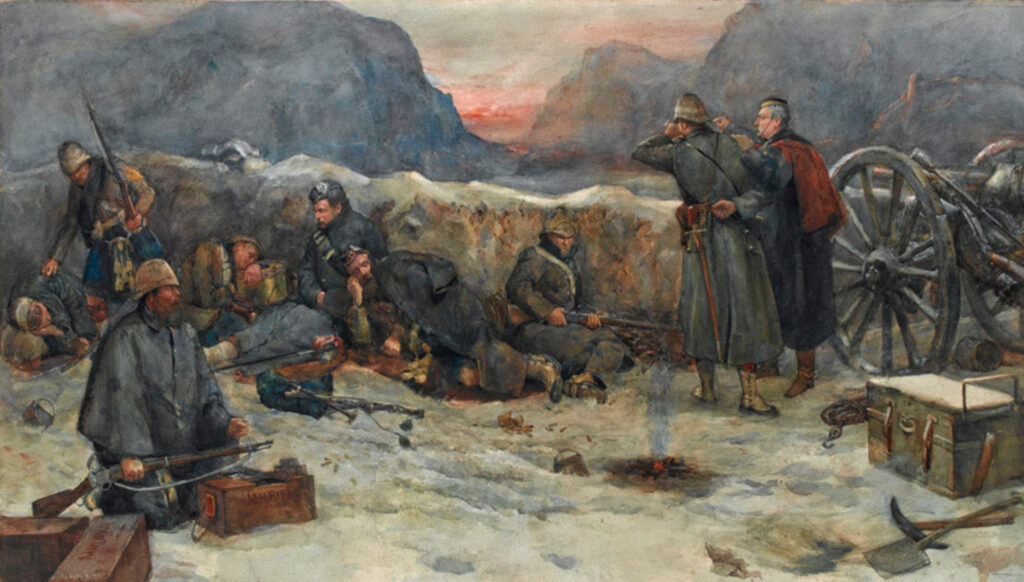
(The bonfire spotted in the distance was the Afghan signal to attack)
Evocations continued - The 1879 Christmas Day celebrations at Sherpur were understandably somewhat muted; it was more a day for rest than festivities. A visiting cleric recalled being struck by the sight of so many empty seats at the mess tables; and of how the hospital was overflowing not just with the wounded, but also those afflicted by the bitter cold and a pneumonia outbreak (c800 men were on the wounded & sick list).
Still during the day a telegraphed message from Queen Victoria was received; extra rations were issued, including plum-puddings made with ‘Kabul raisins’; the Highland Brigades‘ pipers played; and the Signallers built a snowman outside General Robert’s quarters.
Evocations - The British forces in Afghanistan were victorious at Sherpur; but in July 1880 they suffered a disastrous defeat at the Battle of Maiwand. Consequently General Roberts was ordered to evacuate Sherpur and take 10,000 troops on a forced march to relieve the besieged British forces at Kandahar.
In temperatures ranging from 7ºC at night to 40ºC during the day they marched 313 miles in just 23 days; and then fought a battle just outside Kandahar on the 1st September 1880. The Afghan forces under Ayub Khan were defeated; this proved to be the final battle of the 2nd Afghan War, and in April 1881 the last British troops left Afghanistan, but sadly that troubled country has since seen many more battles.
Evocations continued - Amongst the troops at Sherpur were a number of Freemasons, including Brethren from the 9th Lancers and two Highland Brigades; amongst them were two Past Deputy District Grand Masters. Towards the end of 1879 they sought permission from the District Grand Lodge of The Punjab to form a new lodge inside the cantonment; and on the 9th January 1880, just 16 days after the Afghan attack, the Seaforth Lodge No.1866 was ‘consecrated’ at Sherpur.
Although the lodge’s warrant from London would be dated the 3rd June 1880; at that time it took weeks for documents to go back and forth to England, so it was not unusual for new lodges to initially meet using a dispensation from their District Grand Lodge, and the beleaguered Lodge Seaforth certainly had the need for haste.
Evocations - The lodge was named after the family of its Master Elect Captain James Stewart-Mackenzie, later Baron Seaforth; he was jokingly known as ‘Smiler’ as he so rarely smiled! Unfortunately on the 11th December he injured his leg when his horse was shot from under him at the Battle of Killa Kazi, where c200 Lancers charged c10,000 Afghans, so he was not able to take the Chair at the Consecration itself.
Mackenzie served in the 9th Lancers, part of the Cavalry Brigade that played a key role in Sherpur’s defence; he was twice mentioned in despatches, and took part in Robert’s epic march to Kandahar. He retired from the army in 1896 as Colonel of the 9th Lancers; in later life he managed his family estates in Scotland and was an active local philanthropist.
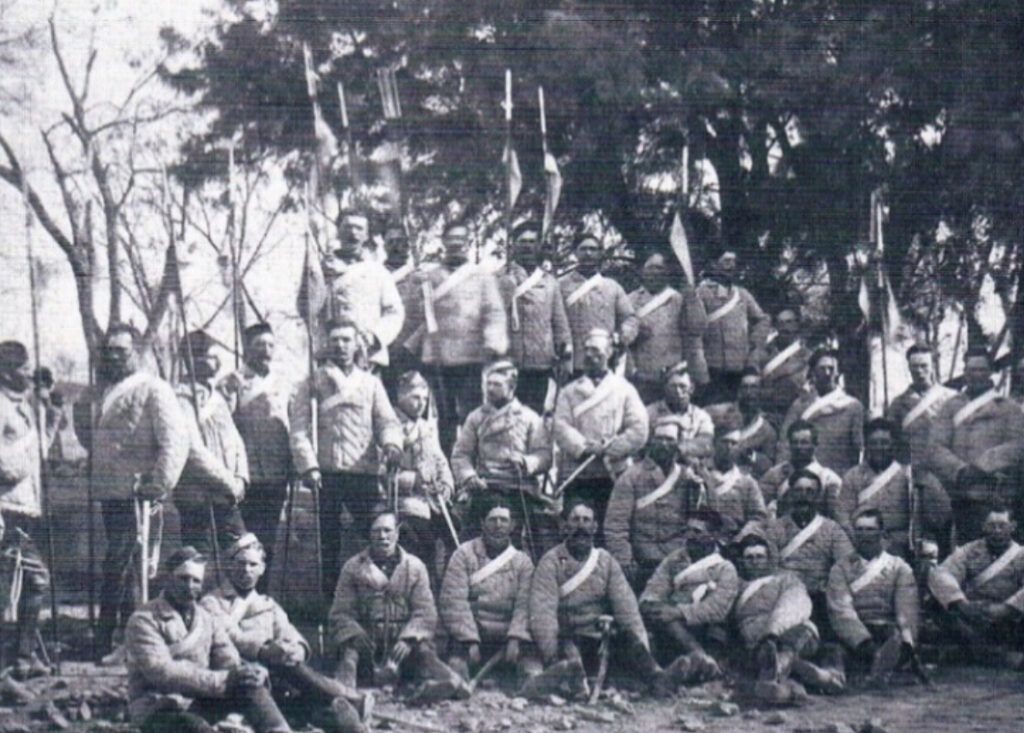

Evocations continued - The Seaforth Lodge was warranted to meet in the ‘Sherpur Club’, which had been formed soon after the garrison moved into the cantonment. A visiting journalist described the club as a popular meeting place for officers of all ranks, where ‘subaltern and Colonel shoulder[ed] each other in true club style’, and friends could meet to share ‘a nip [or two] before dinner’.
Initially the club met in a large tent; but its canvas walls were then replaced with mud and brick walls, incorporating windows and doors; the canvas roof was retained together with the metal chimneys poking through it.
Evocations continued - To transform what was a glorified tent into a lodge room the Brethren had to improvise and make-do with whatever they had to hand; although some may have had their regalia with them, and maybe even a few items of Masonic equipment.
At a meeting of the District Grand Lodge of The Punjab on the 24th April 1880 the DGM gave the following report about Lodge Seaforth: ‘I have had a letter from W. Bro. Gorham, dated 3rd April, in which he expatiates on the good being done by that lodge, and tells me that it has close on 200 members. So that although the youngest of all the lodges in Asia, I may almost say, it is, I fancy a long way the strongest, and while we have such energetic Masons, as W. Bros. Money and Gorham there we may be sure the lodge will prosper under their guidance’.
[The author wonders whether Brother Money is the same individual after whom the West Kent Rosecroix Chapter No.76 is named?]
Evocations continued - When the British forces withdrew from Sherpur in early August 1880 the cantonment was abandoned, and the Seaforth Lodge closed. The local Afghans stripped out everything of value, until all that remained of the ‘Sherpur Club’ was its mud walls; and the lodge’s warrant having been returned it was formally erased by the UGLE on the 10th October 1881.
So why write about a lodge that worked for just seven months, before disappearing into the backwaters of Masonic history?
Evocations continued - Well apart from its historical interest, there is the truly moving story behind its formation. This tells us how a group of soldiers thrown together, under dangerous and difficult circumstances, did for a short while find refuge and comfort, by creating the welcoming familiarity of a Masonic Lodge inside a mud bespattered tent.

This Evocations of a long forgotten Lodge post has been created by the West Kent Military lodge for information. If you would like to now more about the Lodge contact us here

If you’d like to know more about us or how to join our Military Lodge simply click the contact us link and message us your details. We will be very happy to answer any enquiries you may have.

Twitter Feed


