‘Knock knock knocking on heaven’s door’ - Outstanding

Knock knock, who’s there?
Knock knock - Surely a first, using a Bob Dylan song lyric as a Masonic tag line! However, our Masonic ‘Three Knocks’ have a very different meaning and a much older history, their use dating back to at least the early 18th century.

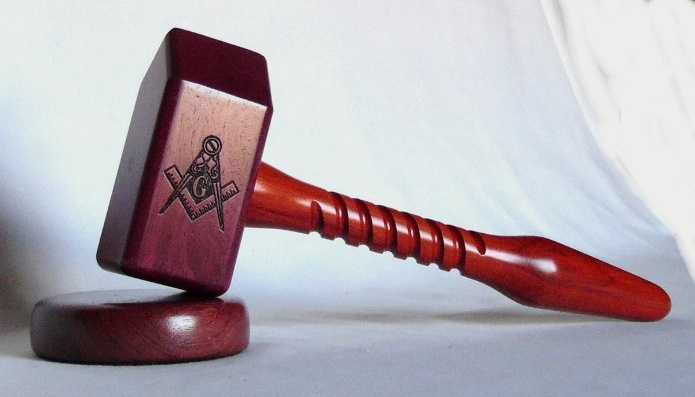
Knock knock - Loud knocks have always been given to maintain order; and at our Installation meetings we place gavels in the hands of the Master and Wardens as ‘emblems of power‘ and to help them keep order in the lodge; but why our ritual’s three knocks?
The number three has many Masonic and religious connotations, but the Masonic Exposures of the 1760s say that these three knocks specifically relate to a passage in St. Matthew’s Gospel ‘Ask, and it shall be given you; seek, and ye shall find; knock, and it shall be opened unto you.’. The first knock signifying that the candidate has sought out Freemasonry within his own mind, the second that he has asked a friend about it, and then only after a third knock can the door of Masonry be opened unto him.

Knock knock - The ‘Sloane MS’ (c1700), an early Masonic exposure, describes the three knocks as ‘two little knocks and the third a big one’; similarly the exposure ‘A Dialogue Between Simon and Philip’ (c1724) speaks of ‘three knocks’ with ‘the last at a double distance of time from the former and much larger’, Although the later ‘Masonry Dissected’ (1730) just says ‘three great Knocks’, and the exposure ‘Three Distinct Knocks’ (1760) not unsurprisingly calls them ‘three distinct knocks’.
None of the early exposures mention the Wardens repeating the knocks, indeed doing so would have been difficult for them when they were stood around the lodge floor drawing, our present Wardens’ pedestals were a later innovation. Early lodge inventories, such as that for the Old Dundee Lodge No.18 in 1739, do list three gavels, but these would have been for when the Brethren were sat around the communal table for lectures and refreshments.
Knock knock - Three knocks were being given in our ritual before Freemasonry had three Degrees; and they were part of just one simple lodge opening ceremony and an equally simple closing ceremony. The Master would just declare the particular Degree to be worked, with the Bible being opened at different place and the position of the Square & Compasses upon it adjusted.
The first clear reference to different knocks for each Degree is in the French Exposure ‘L’Ordre des Francs-Macons Trahi’ (1745); in England different knocks, repeated by the Wardens, probably came into use in the late 18th century as part of new Degree specific opening and closing ceremonies. They were certainly in use prior to the Union of the rival Grand Lodges in 1813; the influential ritualist William Preston was demonstrating different Degree opening and closing ceremonies with their own knocks in the late 18th century, and Browne’s ‘Masonic Master-Key’ (1802) also describes different Degree knocks.
Knock knock - The practice of the Tyler giving a single knock to announce late arrivals was probably a 19th century innovation. Originally late arriving Brethren may have had to give the appropriate Degree knocks themselves on the lodge door; still today in some lodges the Inner Guard will report an ‘alarm’, not a ‘report’, if the knocks he hears are not those of the Degree in which the lodge is open. The practice of the Master giving two knocks to summon the Tyler, and of giving the final knocks with his left hand were also probably 19th century innovations.
Knock knock - As to the gavel itself, the operative use we assign to it as a working tool would better befit the Medieval stonemason’s axe and maul, the tools which they used to knock off ‘knobs and excrescences’. Our gavels are basically hammers; although some Freemasons’ lodges do instead use large round mauls, which they call ‘Hirams’. Uniquely in 1935 Brethren from the Beauchamp Lodge No.1422 and Lodge Jamrud No.4372 would whilst on active service in Afghanistan use tent peg mallets as gavels, and today the West Kent Motoring Lodge at Dartford use converted engine pistons.

This knock knock knocking on heaven’s door post has been created by the West Kent Military lodge for information. If you would like to now more about the Lodge contact us here

If you’d like to know more about us or how to join our Military Lodge simply click the contact us link and message us your details. We will be very happy to answer any enquiries you may have.

Twitter Feed


