
Powerful - His Majesty’s Services:

His Majesty’s Services - A brief guide to British Armed Forces Ranks
His Majesty’s Services - The military of any country is a vital part to keeping the people safe from external threats. In Britain before the 17th century, military forces were usually formed when there was a need to attack someone else or whenever the land itself came under attack, with the soldiers and sailors conscripted from the local populace. The English Army formed as a standing military force in 1660 and in 1707, the English and Scottish armies combined into one operational command. The first rank insignia for the British Army weren’t introduced until 1760 and badges for field officers came about in 1810.
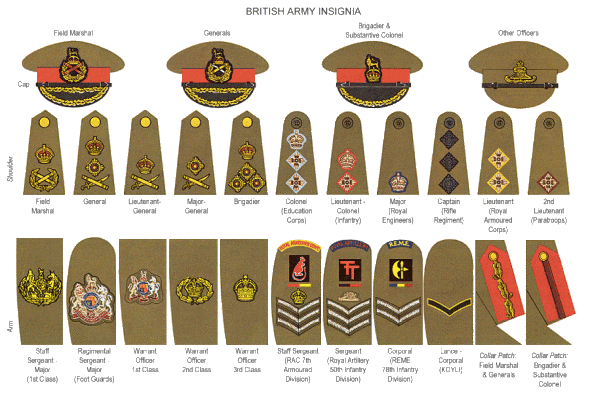
His Majesty’s Services - For the most part, British ranks are very similar to their American counterparts, which is not surprising considering American ranks and military culture was based upon the British. The first enlisted rank is that of Private and actually has no insignia. The next up is Lance Corporal or Lance Bombardier (a Bombardier designating someone in artillery), followed by Corporal or Bombardier, with the former’s insignia being one chevron and the latter having two chevrons. At three chevrons, one is designated a Sergeant.
The next level up presents a difference as a Staff Sergeant has four chevrons and a crown. At this level, the Royal Marines designate this rank as a Colour Sergeant. The highest two enlisted ranks are Warrant Officer Class 2 and Warrant Officer Class 1, the former includes a Quartermaster Sergeant. Class 2 rank insignia is a crown and for a Quartermaster Sergeant, a crown encircled with a laurel. Warrant Officer Class 1 insignia features the Royal Coat of Arms with a laurel as these warrant officers are appointed to the Royal Logistics Corps.
His Majesty’s Services - On the officer side, Officer Cadets are the first rank for Officer Candidates and have shoulder boards with a single white stripe across them. They are referred to as “Mister” or “Miss” rather than by rank and this is true for both the British Army and the Royal Air Force.
The first rank of a commissioned officer is Second Lieutenant and its insignia is a single Bath star (more commonly referred to as a “pip”). A Lieutenant has two pips and a Captain has three pips. At the rank of Major, the insignia is a single St. Edward’s Crown, while a Lieutenant Colonel has one crown and one pip. Colonel has a crown and two pips and a Brigadier has a crown and three pips.
After that, you get into the General ranks, with the first being a Major General whose insignia features a pip over a crossed sword and baton. A Lieutenant General keeps the sword and baton, but the pip is replaced with a crown. A full General has all three symbols: Crown, pip, and sword and baton. At the top is a Field Marshal, an appointed position that is designated by a crown over two crossed batons on a red field surrounded by yellow leaf. On appointment, a Field Marshal receives a gold-tipped baton that he must carry with him on formal occasions.
His Majesty’s Services - Meanwhile, despite the fact that they were both formed in 1660, the Royal Navy’s formation before the Army’s designates it as the “Senior Service”. As stated, Royal Marines, even though they are part of the Navy, have roughly the same ranks as the Army. Enlisted sailors’ ranks begin with Able Seaman with an insignia that simply says “Royal Navy”. The next rank is Leading Rate, the insignia of which features an anchor. Following that is the rank of Petty Officer, which features a crown over two crossed anchors.
A Chief Petty Officer, meanwhile, features a crown over an anchor encircled with a gold leaf. Lastly, much like the Warrant Officer classes for the Army, Class 2 features a crown inside a gold leaf while Class 1 also has the Royal Coat of Arms.
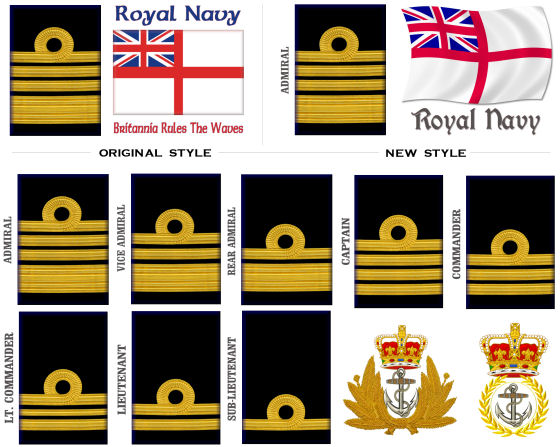
His Majesty’s Services - Naval officers begin with Officer Cadet at the Britannia Royal Naval College before formal training begins, then ascend to the rank of Midshipmen for the remainder of their time at the college. Their first rank on graduation is Sub Lieutenant and the insignia features one gold braid stripe with an executive curl.
A Lieutenant features this curl with an additional gold stripe under it, while a Lieutenant Commander has both a thin gold stripe as well as a medium stripe. A full Commander has the curl with two medium stripes and a Captain has the curl and three medium stripes. Meanwhile, a Commodore’s insignia features a gold loop with a very wide gold lace stripe.
At the Admiralty level, a Rear Admiral’s sleeve features the executive curl with the wide stripe, while also having shoulder boards with a crown and sword and crossed baton over two stars. A Vice Admiral is similar but with three stars and an Admiral has four stars, while their sleeves include a curl and wide stripe with one and two medium stripes, respectively. Lastly, Admiral of the Fleet, much like Field Marshal, features a crown over a sword and crossed baton encircled with silver leaf, while the sleeves have a curl, wide stripe, and three medium stripes.
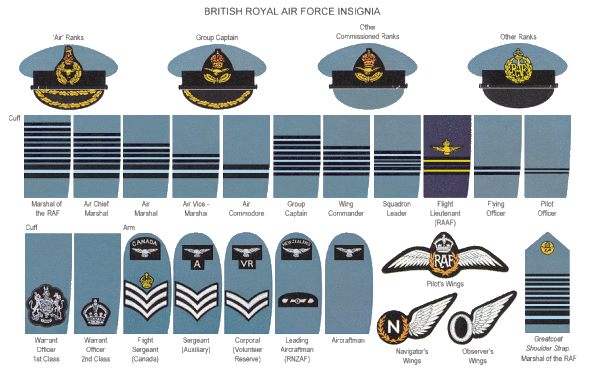
His Majesty’s Services - The Royal Air Force was founded in 1918 and is the most junior service. Its enlisted ranks begin with Aircraftman/woman which has no insignia, while the next rank up, Leading Aircraftman/woman features a two-bladed propeller. Next is Senior Aircraftman/woman which features a three-bladed propeller and if one is a Senior Aircraftman/woman Technician, the propeller is encased in a circle. Chevrons begin to be used at the rank of Lance Corporal, which features one chevron, followed by Corporal at two.
Sergeants get three, but depending on rank and position, may include an eagle for Sergeant Aircrew, a four-bladed propeller for Chief Technician, and a crown for Flight Sergeant with an eagle added for Flight Sergeant Aircrew. Warrant Officers are same as in other services.
His Majesty’s Services - For Air Force Officers, an Acting Pilot Officer has one thin light blue stripe flanked by two black stripes until APO is regarded to Pilot Officer, which has the name insignia. The next rank, Flying Officer, receives a thicker medium stripe. A Flight Lieutenant receives two medium stripes, while a Squadron Leader has two medium stripes with a thin stripe between them.
Moving up the chain, a Wing Commander has three medium stripes and a Squadron Commander has four. Air Commodore is the first to have a thick stripe, Air Vice Marshal has a thick stripe and one medium stripe, while Air Marshal has a thick stripe and two medium stripes, and Air Chief Marshal has three medium stripes.
His Majesty’s Services - Lastly, the Marshal of the Royal Air Force, the top position in the RAF, has a thick stripe with four medium stripes as well as shoulder boards featuring an eagle surrounded by a wreath, two crossed marshal’s batons, and a crown above it all.
Credit John Rabon
The His Majesty’s Service post has been created by the West Kent Military lodge for information. If you would like to now more about the Lodge contact us here

If you’d like to know more about us or how to join our Military Lodge simply click the contact us link and message us your details. We will be very happy to answer any enquiries you may have.

Twitter Feed


