
Courageous Brethren - Arthur Sanders #291

Arthur Sanders’ Family:
Arthur Sanders was born on the 20th January 1877 and was baptised on the 11th February 1977 in Azamgurh, Bengal, India son of Richard Careless Sanders (late Indian Medical Service) and Margaret Cramer (Springett) Sanders later of Holmbush, Barcombe, Lewes, Sussex.
Name:
Arthur Richard Careless Sanders
Conflicts:
First World War
Date of Death / Age:
20/09/1918 - 41 years old
Rank, Unit / Corps & Service Details:
Brigadier General
Royal Engineers
17th Division Commanding 50th Infantry Brigade
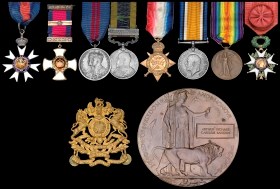
Awards: Service Medals/Honour Awards
Companion of St Michael & St George
Legion d’Honneur
Distinguished Service Order and bar
Mentioned in Despatches x 3
Cemetery/Memorial: Name/Reference/Country:
FIVE POINTS CEMETERY, LECHELLE
D. 6.
France
UK & Other Memorials:
Haileybury College, Cloister Wall Memorial, Hertford Heath, Hertfordshire SG13 7NU
Pre War:
Arthur Sanders was educated at Haileybury College 1891-93 and Army Staff College. Gazetted 2nd Lieutenant Royal Engineers on the 18th January 1897, promoted to Lieutenant in January 1900 and Captain in January 1906, he served in the North-West Province in 1908.
Wartime Service:
After the outbreak of the war, Arthur Sanders was appointed Major and entered France on the 7th November 1914. He was brevetted Lieutenant Colonel in June 1915. Promoted to Brigadier-General, on the 9th September 1918 he took over command of the 50th Brigade of the 17th (Northern) Division in France.
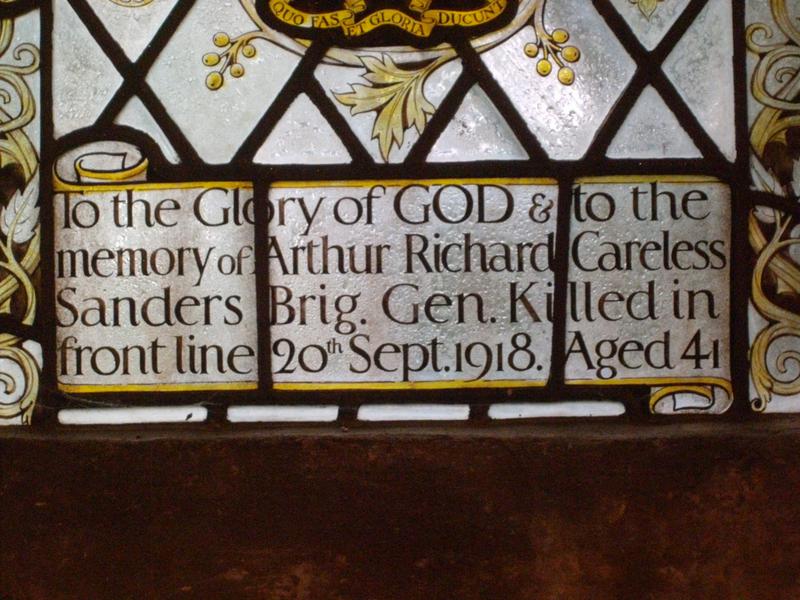
Only eleven days later, in the early morning, he had gone to the front to inspect his men at the Quentin Redoubt* and was returning to Brigade H.Q. when he was caught in machine gun fire from Gouzeaucourt and killed instantly. *Redoubt
DSO as Major and Brevet Lt. Col. Royal Engineers. London Gazette 3rd June 1916.
DSO Bar as Major and Brevet Lt. Col. Arthur Sanders attached 1st Bn. Essex Regiment, “For conspicuous gallantry and devotion to duty. He led his battalion with great courage and determination in an attack, capturing and consolidating all his objectives in spite of heavy fire. It was due to his initiative that a battery of enemy guns in front of the objective was captured. His personal influence and good leadership were largely responsible for the success achieved by the battalion.” London Gazette 2nd December 1918.
12 September - 12 October 1918. As the momentum of the British advance continued it was clear that the Hindenburg Line defences offered the greatest threat to further advances. It was highly likely that the magnificently engineered defence system would re-establish the status quo of static trench warfare.
However a series of magnificent actions at Havrincourt and Epehy paved the way for dramatic crossings of the Canal du Nord and the St Quentin Canal by early October. Both canals had been integrated into the Hindenburg Line system and their capture effectively broke the defensive capability of the system. Soon afterwards the British were attacking at Cambrai (again) and then by mid October were pursuing the Germans to the River Selle.
Masonic:
| Type | Lodge Name and No. | Province / District: |
|---|---|---|
| Mother : | Stewart No. 1960 E.C. | Punjab |
| Joined : | Beauchamp No. 1422 E.C. | Bengal / West Kent |





This Roll of Honour post has been created by the West Kent Military lodge for information, with special thanks to Cher-Leigh Eyles-Thomas for her time researching the content. If you would like to now more about the Lodge contact us here

If you’d like to know more about us or how to join our Military Lodge simply click the contact us link and message us your details. We will be very happy to answer any enquiries you may have.

Twitter Feed


